

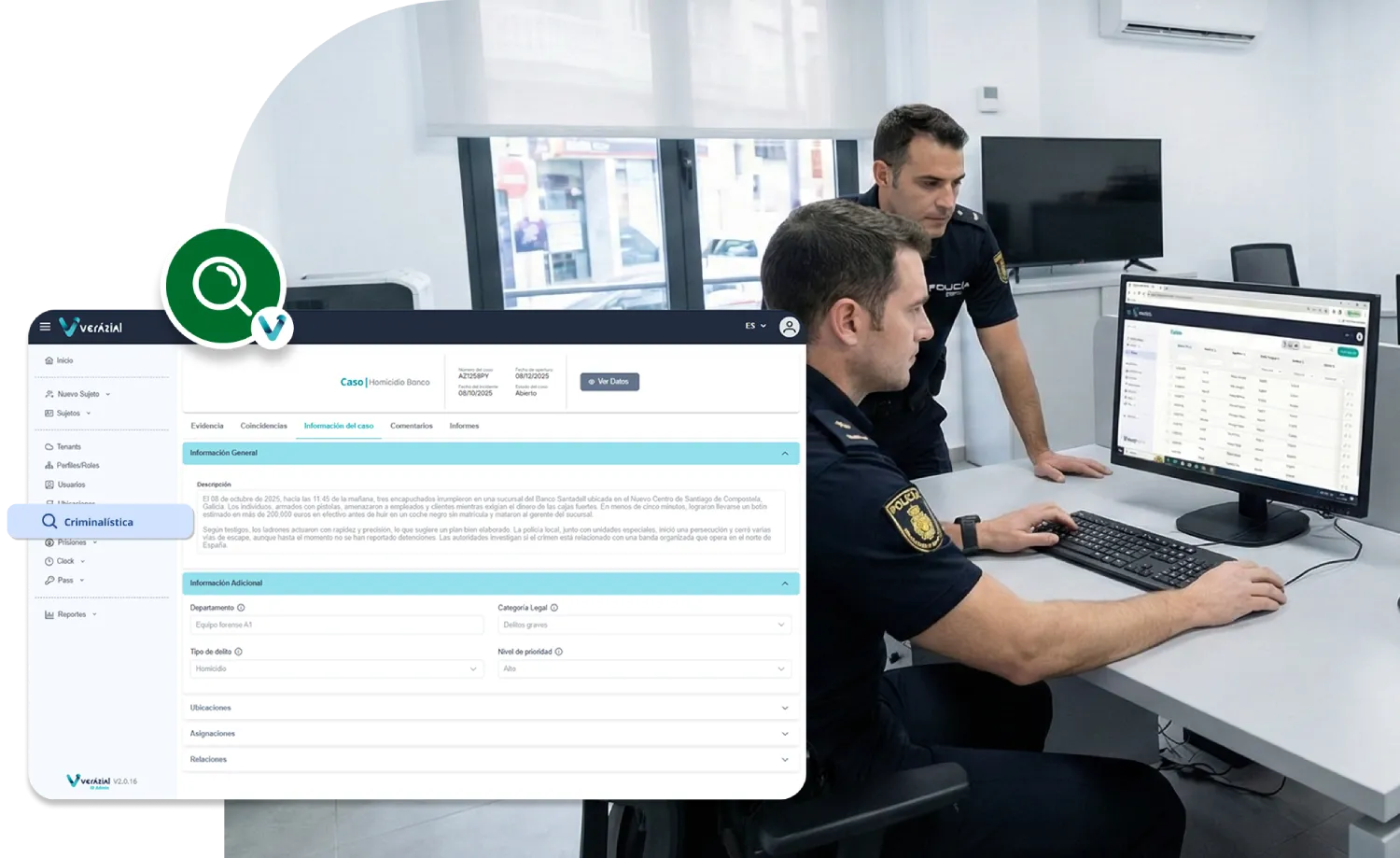
Specialised module for forensics
Identification of suspects/unknown individuals based on their biometric data.
Advanced biometric identification for criminal investigations
Designed to support complex criminal investigations, this Verazial ID Admin module allows forensic experts and investigators to identify individuals from biometric evidence such as latent fingerprints or faces in images and videos, without the need for the subject to be present.
From the laboratory or directly at the crime scene (using mobile devices or fixed stations), it offers advanced tools for managing cases, generating solid evidence for trial and integrating external biometric databases, significantly increasing the efficiency of the identification process.
Using Verázial ID Server and its powerful ABIS
- All subject data is recorded and stored in Verázial ID Server’s powerful ABIS.
- Operations ordered from the workstations of forensic scientists and mobile units are managed against the server’s ABIS, where the following are managed: sample quality analysis, identifications between samples taken live or from latent traces with those recorded, as well as the degree of certainty in the identifications.
- High speed even against large biometric databases.
- Easily scalable to meet growing needs.
- Encryption of stored data for maximum security.
- High availability through configuration in disaster recovery mode (DRC, Disaster Recovery Centre).
General characteristics
1
Highly intuitive and easy-to-use web user interface for all its functionalities related to the registration and identification of biometric samples and the organisation of criminal cases.
2
Compatible with multiple sensors.
3
Comprehensive identity management system with workflow optimised for criminal investigations, configurable for different procedures.
4
Registration of each subject’s file in the ABIS, with biometric and non-biometric data, as well as the history of identifications made in associated criminal investigation cases.
5
Real-time interconnection with other biometric databases (Civil Registry, Electoral Court, Prisons, Police, etc.).
6
Exchange of biometric data with international security agencies, in appropriate formats and standards such as those of NIST.
Registration of biometric samples in the ABIS
- Recording of the 10 fingerprints of a living subject or a corpse, both flat and rolled.
- Recording of palm prints of a living subject or a corpse: upper palm, lower palm, and lateral palm (writer’s palm).
- Registration of fingerprints or palm prints from a file, whether from a criminal record card or card with prints to be digitised, or from a latent sample taken at a crime scene.
- Registration of facial photos of a living subject or a corpse.
- Registration of facial photos from videos or photos collected in a specific case.
- Registration of both irises of a living subject.
- Registration of any biometric sample imported from another biometric system.
- Analysis of the quality of each registered biometric sample.
Criminal case management
- Management of criminal investigation cases, keeping evidence obtained organised: fingerprints, latent prints, photos of faces, scars, marks, tattoos, and other personal data, images and comments relating to the case.
- Information on the burden of proof, metadata, history of biometric identifications carried out on subjects and their results, in which cases they have been previously involved.
Expert identification of latent fingerprints
Latent fingerprints found at a crime scene are often partial and/or barely visible, which poses difficulties for reliable automatic identification and requires the intervention of an expert.
- Specific functionalities for latent fingerprints, providing forensic technicians with the tools for visual biometric auditing and evidence for the creation of legal evidence.
- The matching tool allows for parallel analysis of investigation data with that of different candidates, including minutiae and similarity scores.
- Configurable option so that, if desired, during the comparison process, the forensic expert does not have access to the identities of the subjects being compared until the final result of the comparisons has been decided. This is to avoid any influence on the technical decision.
Editing latent fingerprint images
Latent fingerprint editor to improve fingerprint quality before rolling or passing it for identification against the server:
- Normalisation of the image to a standard that can be used to identify individuals (DPI, perspective, flip, rotate, crop).
- Adjustment of an image to highlight fingerprint ridges (greyscale, brightness and contrast, histogram equalisation, colour temperature, inverted image, blur).
- Visual annotation of significant marks on a fingerprint.
- Ridge separation tool.
- Detection and adjustment of characteristic points.
Available for Windows, web and Android

It works on Windows workstations and Android devices.

Compatible with multiple sensors.
Learn about the architecture and the complete Verázial ID suite
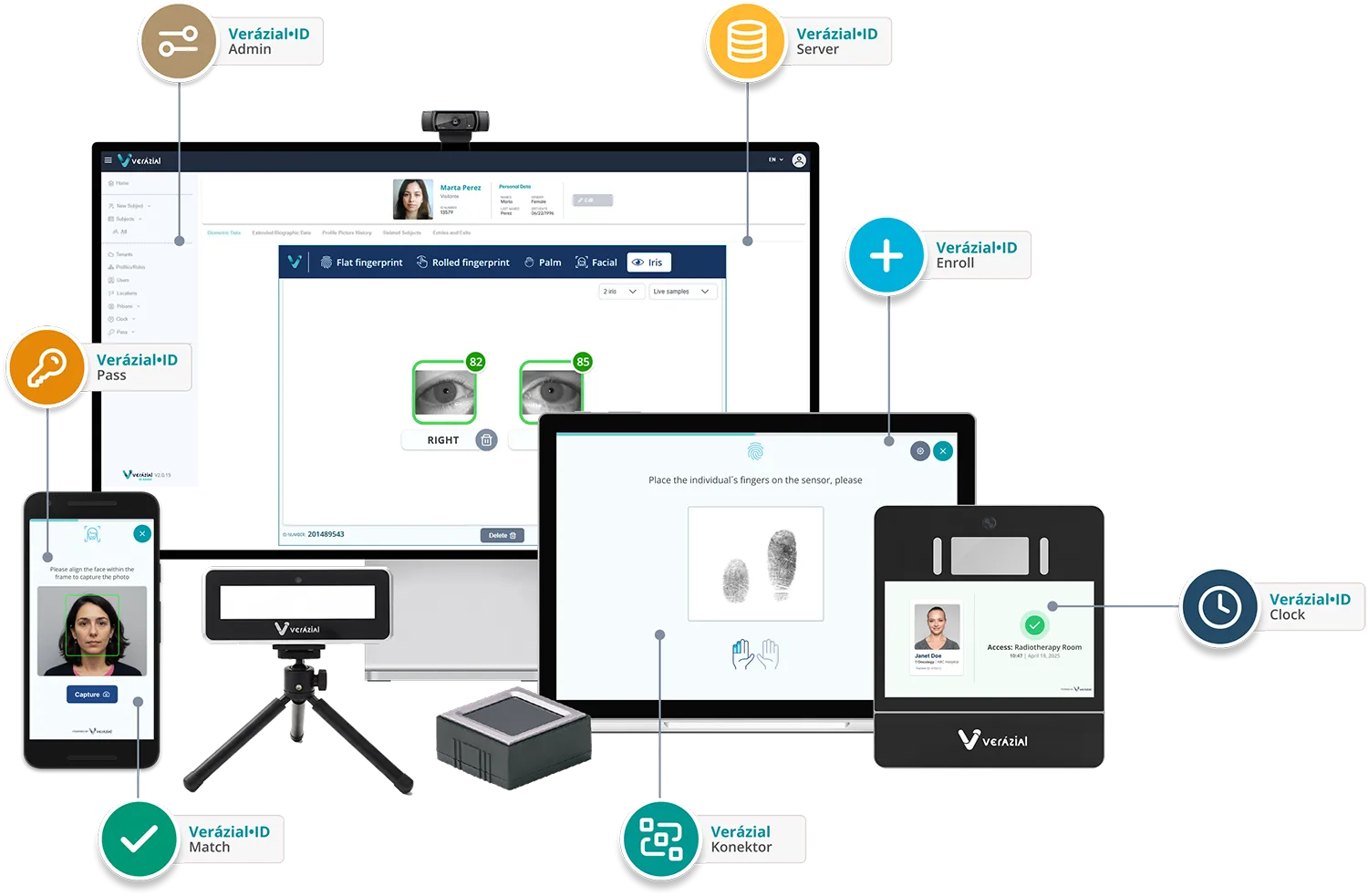

Verázial ID Server
The biometric identity server

Verázial ID Enroll
Records people’s biometric data

Verázial ID Match
Identifies individuals by their biometric data

Verázial ID Admin
Complete management of the biometric database of subjects

Verázial ID Clock
Stock trading with biometric identification

Verázial ID Pass
Logical access control and biometric signature in corporate applications
Specialised module for: Forensics
Do you want to implement secure biometric identification in your system?
Tell us your requirements and we will advise you.
Legal information
We inform you that VERAZIAL LABS SL is responsible for your personal data, which will be processed for the purpose of managing and processing your request, as well as receiving commercial communications about news, products and services, based on your consent. The personal data collected will be transferred, when necessary, for the development, fulfilment and control of the services requested or contracted and as provided for by law. You may exercise your data protection rights at gdpr@verazial.com.