

The accuracy of a biometric system doesn’t depend solely on iris, fingerprint, or facial recognition. Configuring metrics like TAR, FAR, and FRR determines the balance between security and usability. In this article, we look at their differences, as well as the threshold configurations and biometric technologies that suit each sector of application best.
In the world of biometric identification, several terms are key to assessing the robustness and reliability of a biometric system. Among these, the technical metrics TAR, FAR, and FRR stand out. These indicators make it possible to objectively describe and compare the performance of different biometric solutions and their limitations.
What Do These Metrics Measure?
In an identification process, the system captures a biometric sample and compares it against the records stored in the database. The result of that comparison can be correct or incorrect, leading to the following situations:
- True positive: The system correctly grants access to an authorized person.
- False positive: The system mistakenly grants access to an unauthorized person.
- True negative: The system correctly rejects an impostor.
- False negative: The system incorrectly denies access to an authorized person.
These four cases serve as the basis of the three fundamental metrics.
TAR
The True Acceptance Rate measures the proportion of legitimate access attempts that the system correctly accepts; in other words, the true positives. A TAR of 99,5% means that out of every 1.000 attempts by authorized individuals, 995 are correctly identified.
TAR is the metric that most directly reflects the system’s operational efficiency, since a low TAR means constant workflow disruptions, user frustration, and reliance on manual backup procedures, while a high TAR means the identification system is effective and gets it right in the vast majority of cases.
FAR
The False Acceptance Rate measures the proportion of illegitimate access attempts that the system mistakenly accepts; in other words, the false positives. This metric measures the system’s security risks. A FAR of 0,01% means that for every 10.000 unauthorized people, the system mistakenly accepts 1 of them.
For this reason, the FAR should be as low as possible in high-security environments, since a high value amounts to a systemic security breach.
FRR
The False Rejection Rate measures the proportion of legitimate access attempts that the system mistakenly rejects; in other words, the false negatives. An FRR of 0,5% means that out of every 1.000 access attempts by legitimate users, the system blocks 5 of them.
This rate affects the system’s operational cost and user experience. A high FRR can turn into a serious logistical problem.
The Threshold Dilemma
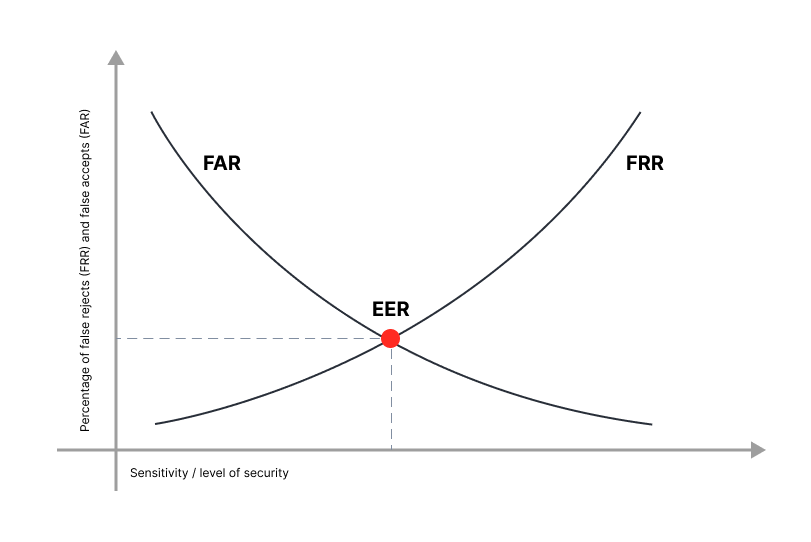
These two parameters, FAR and FRR, are in permanent tension with each other and depend on the decision threshold configured in the system. Lowering the threshold makes the system more permissive; as a result, FAR increases and FRR decreases. Raising the threshold makes the system stricter, consequently the FAR decreases and the FRR increases.
The point at which the FAR equals the FRR is called the Equal Error Rate (EER), and it is the most commonly used benchmark for objectively comparing biometric systems. A low EER implies a high TAR.
But choosing the threshold isn’t just a technical decision, it’s a strategic one. Each organization must find its own balance between security and operability, based on the real cost each type of error would carry in its specific context.
Accuracy of Different Biometric Technologies
Each biometric technology offers different performance:
- Iris recognition is the most precise, with an EER of around 0,0001 %, making it the best option when a mistake would have critical consequences. You can find more information in our article Iris recognition: Accuracy and security in biometric identification.
- Fingerprint recognition has a FAR below 0,001%, but it varies significantly depending on capture conditions. For more details, we invite you to read our article Fingerprint biometrics: The oldest form of biometric identification.
- Facial recognition is the most convenient, but since it’s sensitive to external factors such as lighting, it has a higher EER in mass identification. More in our article on Facial biometrics: Fast, convenient and reliable identification.
However, the most secure and accurate modality is multimodal biometrics, since it multiplies security and reduces both FRR and FAR. To learn more about its advantages, we invite you to read our article Multimodal Biometrics: Why combining Iris, Fingerprint, and Facial Recognition enhances security?.
Threshold Configuration based on the Sector
Every sector has a different tolerance for error, which is why threshold configuration must vary according to context.
- In the pharmaceutical industry, according to the GMP regulations, FAR must be practically zero, since an identification error compromises traceability and regulatory compliance.
- In hospitals, misidentifying a patient before a transfusion or a radiotherapy session can have irreversible consequences, which makes FAR the priority metric in this sector.
- In correctional facilities, balance is essential, since an excessively high FRR slows down internal controls at critical moments, while a high FAR compromises the safety of others.
- In criminalistics, where comparisons are made against latent fingerprint databases rather than in real time, reducing FRR is a priority to avoid leaving cases unsolved.
In short, choosing the right FAR and FRR threshold isn’t a minor configuration detail, it’s the first line of defense for any organization that relies on biometric identification. Because when that threshold isn’t properly configured, the errors have real consequences.
Discover how Verázial ID integrates multiple biometric modalities, adapting to the requirements of each sector to deliver maximum security and a frictionless user experience.
Contact us for a demo and/or personalized assessment.
References
- Image © Verázial Labs.
- Recreated from a figure published on ResearchGate.